Real-time production insight, VR and layouts
Kamstrup · Denmark · 2021–2023
Kamstrup makes smart meters for energy and water. During my master’s I worked with its production and LEAN departments, and I was responsible for the company’s VR strategy and development.
In numbers
- Time: a stopped line shows on the live view within 5 seconds instead of in the next morning’s report. The layout algorithm drafts a layout in 3 minutes instead of about 2 weeks of planning by hand.
- Money: shorter routes save about 600 hours of transport a year, around €27,000. One VR test caught a problem before a rebuild that would have cost about €25,000.
- Errors: the live view showed that 23% of downtime came from stops shorter than 5 minutes, which the daily number never showed. The figures come straight from the machines, so nobody types them in.
- Adoption: 24 decision sessions with 9 senior leaders from 3 departments, and 40 employees tried the VR simulations.
- Scale: 3 production lines in one live view, a 1,800 m² real layout, and more than 5 VR and digital twin projects.
Deciding together what to build
I ran regular learning sessions with senior leaders from manufacturing systems (MES), supply chain and the LEAN department. In those sessions we decided which VR apps to build, which experiments to run and what to test next.
A real-time view instead of a daily number
I was asked for OEE (overall equipment effectiveness) per day. A daily figure shows losses only after the shift is over, so I built a view that updates every second instead. It was reviewed by supply chain and LEAN leadership.
OEE multiplies three things: how much of the planned time a line actually ran, how fast it ran compared with its ideal speed, and how many of its parts were good. A daily number mixes a ten-minute jam at 8:00 with a slow afternoon. Live, you see the jam while it is happening and can send someone to fix it.
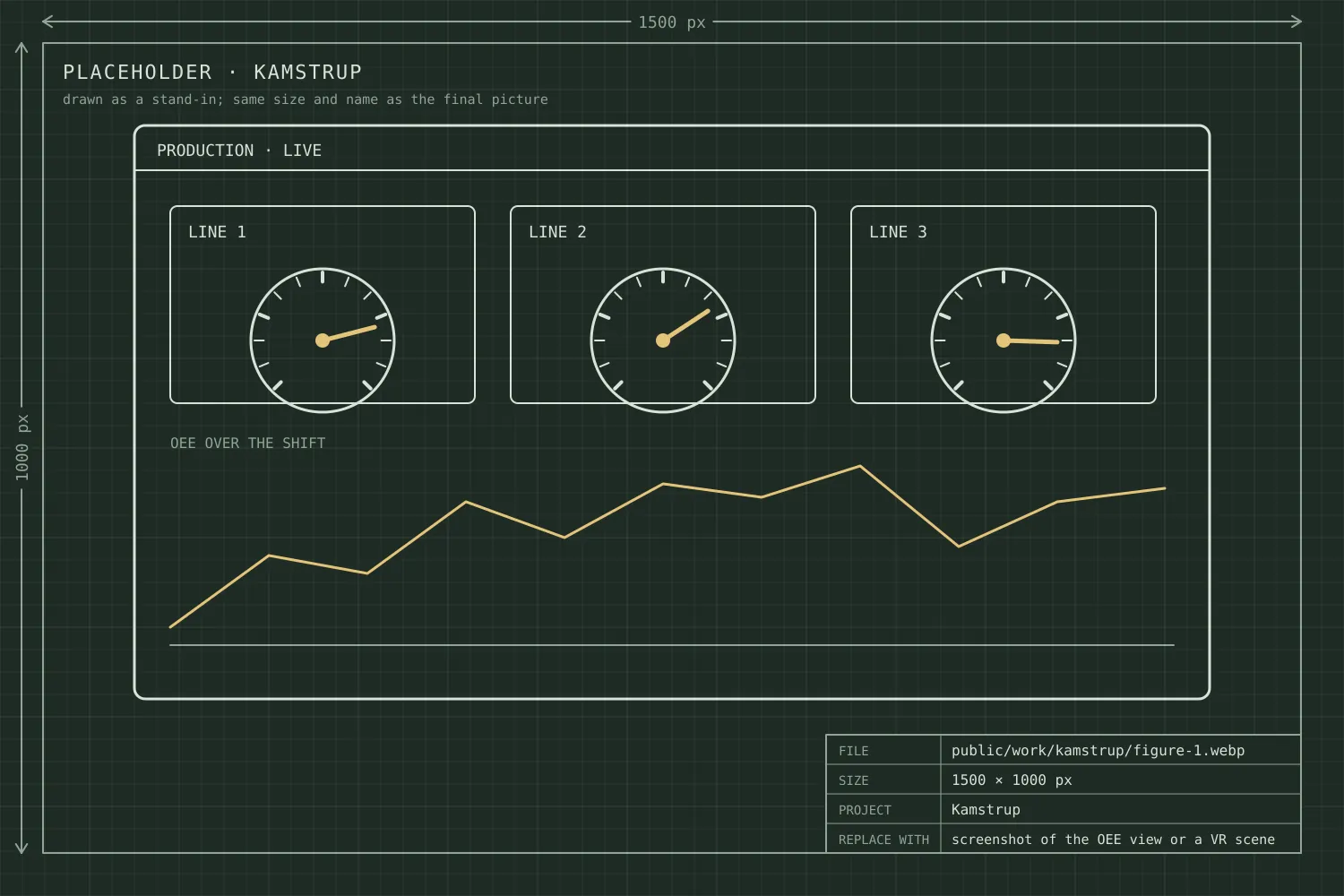
3 lines, one view, updated every second.
Layouts planned for people and machines
I designed an algorithm that generates production layouts automatically. It places people and machines so the work flows best, based on where everything stands on the floor. I presented it to leadership and tested it on a real production layout, where it cut the distance parts travelled by 18%.
VR and digital twins
- VR prototypes and simulations that let production and LEAN teams try process changes before touching the real line.
- Digital twins with security and controlled access, built to comply with internal IT policies.
- Visualization tools that helped teams across departments make decisions faster.
In total I delivered more than 5 simulation and digital twin projects, built in Unity and Unreal Engine.
Beyond building
I also assessed technology needs and the cost-effectiveness of proposed digital transformation projects.